Post navigation

Younger Customers Like Brands, but Older Customers Have a Higher CTR

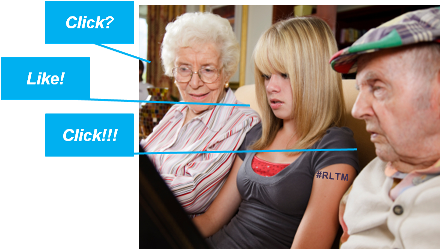
Younger adults prefer to interact with brands on social media and are more likely to "Like" a brand on Facebook.  But older adults deliver a higher CTR.

The social media generation gap: some click to Like, and some just like to click.

In the last week, two separate studies have been released that look at how consumers interact with brands on social media.  We always love it when two independent sources confirm the findings, so we decided to share both studies in one post.  Both studies focus on how different types of consumers interact with brands on social media sites.  The “American Millennials” survey, conducted by Barkley surveyed over 3,000 Millennials aged 16-34.  The SocialCode study examined over four million data points for ads containing a ‘Like’ button across over 50 clients in different verticals for the past ten months and analyzed trends across age and gender demographics.

The bottom line:  younger adults are more likely to check out brands on social media sites, and they are more likely to hit the “Like” button on Facebook.  But don’t take down your web site down just yet:  older consumers prefer to click, not like.  On average, CTR’s are 30% higher for consumers age 50+.

Millennials and Brands on Social Media (from “American Millennials“):

  • over half of consumers ages 16 to 34, 53%, liked checking out brands on social media sites. That compared with just 36% of older adults.
  • 33% of Millennials like brands more if they use social media, nearly double the percentage of older adults who said the same (17%).
  • One-third of Millennials (33%) agreed with the statement that they “find brands on social media sites like Facebook and Twitter annoying” — but only 25% of older adults agreed with the same statement.
  • Nearly one in four Millennials (23.5%) interacted with content from a brand’s Facebook page at least once a daily, vs. 17% of older adults who did the same.
  • Overall, older adults were nearly twice as likely never to engage with brand content on Facebook.

Older Adults and Brands on Social Media (from the SocialCode study)

  • 50+ year-old users, the oldest segment in the study, are 28% more likely to click through and 9% less likely to ‘Like’ than 18-29 year-old users, the youngest group observed.
  • 50+ users see a 23% higher CTR and 8% percent lower ‘Like’ rate when compared to the rest of the population studied.

Gender and Brands on Social Media (from the SocialCode study)

  • Overall, women are 11% more likely to click on an ad.
  • ‘Like’ rates are almost even for men and women; men are actually 2.2 percent more likely to ‘Like’ an ad than women.
  • For women, CTR is 31% higher for the 50+ age group versus 18-29 year olds, men only see a 16% difference between the age groups.
Have you seen similar variances with different types of consumers?  Why do you think older adults are so much more likely to click on ads?  And will there always be a technology generation gap?
  • http://freetraffictip.com Tinu

    I was just talking about Like vs Click over at Web Pro News. I’d like to see an article from you about this over there, tonia_ries . ;)

  • http://therealtimereport.com/ tonia_ries

    @Tinu thanks! What do you think accounts for the difference in Likers vs Clickers? Are older people just more comfortable with clicking, and maybe not sure of the benefit of hitting “Like”? Or are younger people more resistant to clicking because they are more cynical? Would love to hear your theory on this.

  • HotBlogTips

    @Tinu @tonia_ries cause we rock steady!

  • tonia_ries

    @HotBlogTips @Tinu Hah! first good answer I’ve seen yet!! :-)

  • Tinu

    @tonia_ries @HotBlogTips LOL Ditto. Instant follow. :)

  • tonia_ries

    @Tinu @HotBlogTips +1

  • http://dannybrown.me/ DannyBrown

    I’m wondering how much of this has to do with mobile browsing? The younger demographic is more web-savvy, at least from a mobile angle, while an older one prefers desktop.

    So when it comes to real call-to-actions (buy now, do banking, pay a bill, etc), the desktop browser is still seen as more secure than the mobile one. So, more trust in clicking to do something as opposed to liking something?

  • http://therealtimereport.com/ tonia_ries

    @DannyBrown that could definitely be a factor. The SocialCode study specifically analyzed Facebook ads that had Like buttons in them (young people were more likely to click the Like button; old people more likely to click the ad itself) so it seems there’s something going on beyond just the platform, too.

  • http://freetraffictip.com Tinu

    Whenever someone asks me about older users, @tonia_ries , I think of two people, my mother and debbieweil . Now, I don’t consider either of those people old, but Debbie comes to mind because of her expertise on the matter. And my mother comes to mind as the example of the vibrant boomer who uses the web but isn’t a heavy user. And thinking of it from my Mom’s point of view, I believe it’s the word “Like” or even “Recommend” – I think she takes it more literally and wouldn’t click Like on something she doesn’t know about yet. And since she understands what the Like button/link does, she is also looking for a less cluttered experience of Facebook. Then there’s the privacy issue – if she clicks it people/companies will know that much more about her, perhaps she doesn’t want to be marketed to unless she’s a true fan of the product. I’ve also noticed that the older my friends are, the more likely they are to have the view of Facebook as being for friends and family communication only. My niece likes it for friends, relatives, people she is friendly with, possible employers, people she has never, and may never meet who she shares interests with… her willingness to present her sub-identities is more fluid.

    I think Debbie can add a lot more to this conversation. She did a presentation at Ignite DC about boomers that I found engrossing.

  • http://therealtimereport.com/ tonia_ries

    @Tinu these are excellent points. To sum up: older people are more literal about defining roles in the digital world, while younger people are more fluid about moving between different types of relationships. And older people are definitely more concerned about privacy. There are of course outliers to these generalizations, but I have seen research to suppor this. Would love to hear from debbieweil on this, too!

Post navigation